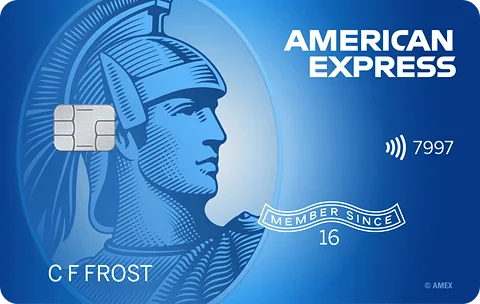
Blue Cash Everyday: 3% at supermarkets, online and gas, each capped at $6,000
A no-fee card paying 3% at U.S. supermarkets, online retailers and gas stations, up to $6,000 each a year; it suits a household whose stores qualify.
The short answer
Blue Cash Everyday from American Express is a cash-back card with no annual fee. It earns 3% at eligible U.S. supermarkets, U.S. online retailers and U.S. gas stations. Each category has its own $6,000 annual cap, then earns 1%, and other purchases generally earn 1%.
In Julia's example, a household that spends $7,200 at supermarkets, $3,600 online and $2,400 on gas, plus $6,000 on ordinary purchases, earns $432 a year. A 2% card such as Citi Double Cash earns $384 on the same spending, so Everyday is ahead by $48 before credits or offers.
The card suits a household whose normal supermarket, gas and online purchases qualify, with a second card for the gaps. A household whose groceries come from excluded stores, or whose online spending is mostly services, may find a flat 2% card simpler and higher earning.
What it costs
There is no annual fee, and the Studio's record shows no membership cost. The comparison throughout is a 2% card, such as Citi Double Cash. Julia also weighs the card against its paid sibling, Blue Cash Preferred, whose regular annual fee is $95 after the introductory waiver.
Two costs sit outside the rates. Purchases abroad carry a 2.7% foreign transaction fee, so a card with no foreign fee may fit better there. And the rewards pay off only when you pay without interest, because carrying interest-bearing spending can cost more than the bonus categories earn.
What it earns
- 3% at eligible U.S. supermarkets, up to $6,000 a year, then 1%.
- 3% at U.S. online retailers, with its own $6,000 annual cap, then 1%.
- 3% at eligible U.S. gas stations, with its own $6,000 annual cap, then 1%.
- 1% on other purchases generally.
The caps are separate. Using the supermarket allowance does not use up the online one, so $6,000 in either category can earn $180. Julia would not retire the whole card once one cap is reached; she would move only the purchases that have dropped to 1% and leave the other useful categories working.
The rewards are Reward Dollars, not Membership Rewards points. Each Reward Dollar gives you $1 as a statement credit, and you cannot transfer them to an airline. Amex also allows eligible Reward Dollars at Amazon checkout at the same value as a statement credit, a rule for this currency only.
The credits, used honestly
The card has one credit: after enrollment, up to $7 a month toward a qualifying subscription bought directly through the eligible U.S. Disney+, Hulu or ESPN websites. Eligible bundles can count. If you already spend at least $7 a month that way, the credit could replace up to $84 a year.
Timing decides whether it is worth that. A subscription kept for 6 eligible months supports a maximum of $42, an annual plan charged once does not trigger 12 monthly credits, and an unused month's credit cannot be redeemed later. Do not count a saving that is already covered somewhere else; one subscription bill cannot save the same dollars twice. The Studio also tests a year without its biggest counted credit, so the credit is not treated as a certain saving.
Purchase protection is the other benefit, with covered events, time limits and exclusions. In the Studio's checks, an eligible item accidentally damaged on day 30 is paid in full, but the trip check finds no documented benefit, because Amex's cancellation directory does not list the card. Protection can be useful without counting as annual savings.
The catch
The online rate is for qualifying physical goods. Paying insurance, utilities, streaming or travel on a website does not turn a service into retail merchandise: a desk or clothing can fit, and a bill may not. Even at the same store, an online purchase can be treated differently from an in-person one, and digital wallets and intermediaries can affect the information Amex receives. Look at how the actual purchase posts, because a familiar store name alone does not promise the same reward through every payment route.
The supermarket category does not automatically include superstores or warehouse clubs, and buying groceries there does not change a store's classification. The Studio's record says so: "Superstores and warehouse clubs do not earn the supermarket bonus." Gas means eligible U.S. gas stations, not every business selling fuel, and it does not automatically include every charging transaction.
A welcome offer can help an eligible new account, but amounts and requirements vary, so Julia leaves welcome bonuses out of her recurring comparison.
Who it fits
It fits a household whose normal supermarket, gas and online-retail purchases qualify, with a fallback card for ordinary spending and for purchases above the caps. Julia checks the category totals occasionally and switches later purchases once an allowance is used. It fits less well a household buying groceries at excluded stores, or one that spends abroad.
On the Studio's everyday card test the card scores 67 out of 100. The test weighs value after costs across 3 household budgets, then reward freedom, effort and 2 specific protections. The category mix helps, with no annual fee to recover; the caps and the monthly credit take attention, and the ordinary rate is only 1%.
Before paying for Blue Cash Preferred, Julia wants the upgrade to improve the purchases her household actually makes. Everyday's $72 online-shopping advantage belongs in that decision.
The arithmetic
Julia's year has $7,200 at qualifying supermarkets, $3,600 at eligible online retailers, $2,400 at U.S. gas stations and $6,000 of ordinary purchases.
- Everyday: supermarkets earn $192 (the first $6,000 earns $180 and the last $1,200 earns $12), online retail adds $108, gas adds $72 and ordinary purchases add $60. The total is $432.
- A 2% card earns $384 on the same spending, so Everyday wins by $48.
- Together: Everyday on the three categories and a 2% card on the ordinary spending and the groceries beyond the cap earn $504, or $120 more than the flat card alone.
- Price first: a desk costs $200 at an eligible online retailer or $195 in the store. Online, 3% back brings it to $194; in person with a 2% card it is $191.10, so the lower price and lower rate save $2.90. An extra percentage point adds just $1 on a $100 purchase.
- Upgrade check: on the $3,600 online budget, Everyday earns $108 and Preferred normally $36, assuming no other category applies, so $72 is given up. On a $3,000 supermarket budget, Preferred earns $180 and Everyday $90, and the extra $90 does not cover Preferred's $95 fee by itself.
Before you apply
Confirm the category rates and the $6,000 caps on American Express's page, along with the current Disney credit terms and enrollment steps. Check a recent statement for which of your purchases would qualify, since the fit that holds up may be the card you can keep without an annual fee. The Studio checked these terms on October 6, 2026.
Rewritten from Julia’s review script (1,184 words); every figure traces to the script or this card’s record. Terms checked Oct 6, 2026.