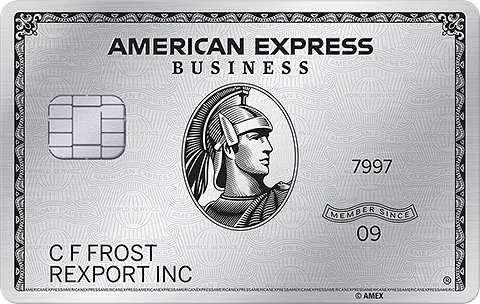
Amex Business Platinum: an $895 fee that Julia's example clears by $17.40
An $895 card whose credits and 5-point travel rate leave Julia's example $17.40 ahead of a 2% card, or $287.40 ahead at 1.5 cents per point.
The short answer
American Express Business Platinum is a premium business rewards card with an $895 annual fee. It earns 5 Membership Rewards points per dollar on eligible flights and prepaid hotels through Amex Travel, 2 points in a short list of business categories and 1 point on other purchases. It also carries lounge access, booking benefits and statement credits.
The credits and lounge visits cover the fee only when the business already pays for what they cover. In Julia's example the benefits she would actually use total $770, leaving $125 of the fee. Adding the extra rewards over a 2 percent card puts the card $17.40 ahead, or $287.40 ahead if the points are worth a net 1.5 cents.
The Studio gives it a Business Wallet Score of 47 out of 100. Its fit note reads, "Traveling businesses already paying for the specific covered services." Its limitation reads, "Large fee; most advertised lifestyle/status benefits have no cash value in this test."
It suits a business that travels and already pays for the specific services the credits cover. It does not suit one that would book trips, buy equipment or keep subscriptions only to trigger a credit.
What it costs
The annual fee is $895. Julia judges the card against a year of trips, bills and spending, and counts only benefits that replace spending the business would make anyway.
Employee Business Platinum cards have a separate annual charge. A no-annual-fee employee expense card is also available, with limited benefits, and someone who only orders supplies may not need the paid travel card.
In her example the card is measured against a no-fee 2 percent card within its cap, and against the cheaper hotel she would book without Platinum. No preset spending limit does not mean unlimited spending, and Pay Over Time can charge interest.
What it earns
Under the earning rules Julia checked in October 2026:
- 5 points per dollar on eligible flights and prepaid hotels through Amex Travel. Direct airline bookings do not get that rate on Business Platinum, even if the personal Platinum card's rules differ.
- 2 points per dollar on eligible U.S. construction-material and hardware suppliers, electronics retailers, software or cloud providers and shipping providers, and on eligible purchases of at least $5,000.
- 1 point per dollar on other ordinary purchases.
The 2-point categories share a cap of $2,000,000 each calendar year, and meeting 2 conditions does not stack the rate into 4 points. The Studio's rate card lists 2 points on shipping and software and values a point at 1 cent.
The credits, used honestly
The Studio's rate card counts five credits: hotel, wireless, Dell, airline incidental and Hilton. Julia counts a credit only if it replaces spending the business would make anyway, and counts everything else as 0.
Julia describes the hotel credit as up to $600 per calendar year, split into up to $300 in each half. It covers qualifying prepaid Fine Hotels + Resorts or The Hotel Collection bookings through Amex Travel, and The Hotel Collection needs at least 2 nights. If you do not need a qualifying stay, leave the allowance out. The Studio's rate card carries a $300 face value and counts only a planned-use amount of $100, $200 or $300 across its 3 budgets, so check the issuer's page for the current amount.
Other credits follow different schedules: airline incidentals need a selected airline, wireless credits are monthly, Indeed credits are quarterly and Adobe needs qualifying spending first. Dell has a base credit plus an additional credit tied to much larger spending, and eligible ChatGPT Business and Hilton credits have enrollment and purchase rules. Check that each credit's window matches the bill it would cover.
Julia's example counts $120 of wireless credits, a $250 Adobe credit for a business already spending at least $600 directly with Adobe, and $100 of eligible airline incidentals. The Studio's rate card counts the wireless credit at $120, the airline incidental credit at up to $120, the Dell credit at up to $150 and the Hilton credit at up to $150, and it does not count Adobe.
Julia counts 12 eligible lounge visits that each replace $10 of food she would otherwise buy, not day-pass prices she would never pay. Entry depends on airline, fare, guest, enrollment and capacity conditions, and the Studio gives lounge access and status no cash value unless a modeled expense is replaced.
The catch
The margin is thin. The $17.40 depends on every assumption holding: if the business no longer needed Adobe, losing the $250 saving would wipe out the advantage. Julia would not renew on the assumption that last year's needs still applied.
Credits only count when they replace planned spending. Booking a hotel just to use the hotel credit, or buying unneeded equipment to trigger a Dell credit, creates an expense you had not planned, and unused benefits stay at 0.
Pay with Points can raise a redemption's value, but you need the points up front and must meet the flight and timing rules. A 35 percent airline bonus returns points on eligible flights through Amex Travel with the selected qualifying airline, up to 1,000,000 returned points a year. On an eligible $500 flight at 1 cent per point, 50,000 points go in, 17,500 come back, and the net cost of 32,500 points is about 1.54 cents each. A transfer award can price the same flight very differently, so compare both.
Who it fits
It fits a business that travels and already pays for the covered services: wireless bills, a qualifying hotel stay, a selected airline's incidental fees, a software subscription that meets the spending threshold and lounge visits that replace food it would buy. In Julia's example those add up to $770 of benefits, alongside 54,000 points on a $20,000 card budget.
It fits less well a business whose needs have changed since last year, one that would rely on a redemption it cannot book, or one that would value lounge access and status as cash. Julia notes that comforts you would willingly pay for can still matter personally, but they are separate from the savings you can demonstrate.
The arithmetic
Julia's example is a $20,000 annual card budget.
- Hotel: Amex charges $500 for a stay Julia could book elsewhere for $380. A $300 credit leaves the Amex booking at $200, so the saving is $180, not the advertised $300.
- Benefits: $120 of wireless, $250 for Adobe, $100 of airline incidentals and $180 of hotel savings make $650. Twelve lounge visits replacing $10 of food each add $120. That is $770, which leaves $125 of the $895 fee.
- Points: $8,000 on Amex Travel flights and prepaid hotels at 5 points earns 40,000, $2,000 of software at 2 points earns 4,000, and $10,000 of other expenses at 1 point earns 10,000. That is 54,000 points, or $540 at 1 cent each.
- Alternative: booking the $380 hotel makes comparable spending $19,880, and a no-fee 2 percent card within its cap earns $397.60. Platinum adds only $142.40.
- Result: $142.40 plus $770 minus the $895 fee leaves $17.40 ahead.
At a net 1.5 cents per point, 54,000 points are worth $810, and the same spending and benefits leave $287.40 ahead. Julia would want an available redemption that supported that value before relying on it.
Before you apply
Check Amex's page for the current annual fee, each credit's amount, schedule and enrollment, especially the hotel credit, where the Studio's rate card counts less than the full allowance. Check the lounge conditions, the Pay with Points bonus and cap, employee card fees and the earning categories.
Julia checked the earning rules and the $895 fee in October 2026, and the Studio's record was checked on October 6, 2026. Terms may have moved since the video, and the $20,000 budget and the credits used are assumptions to replace with your own.
Rewritten from Julia’s review script (1,348 words); every figure traces to the script or this card’s record. Terms checked Oct 6, 2026.