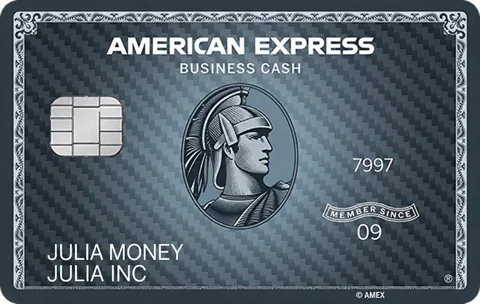
Amex Graphite Business: a $295 fee that a no-fee 2% card beats below $79,500
A $295 business card with an uncapped 2% and 5% on Amex Travel flights and hotels. In Julia's example it leads Blue Business Cash by $105 at $90,000.
The short answer
The Graphite Business Cash Unlimited Card from American Express has a $295 annual fee and pays 2 percent on eligible purchases, with no annual spending cap on that rate. It also pays 5 percent on eligible flights and prepaid hotels booked through Amex Travel online or its app. That is 5 percent in total, not on top of the 2 percent.
Against Amex Blue Business Cash, which has no annual fee, Graphite pulls ahead only at about $79,500 a year of eligible purchases. In Julia's example, a business spending $38,000 earns $760 on either card before the fee, and one spending $90,000 ends $105 ahead on Graphite.
The Studio gives it a Business Wallet Score of 67 out of 100. Its fit note reads, "High-spend businesses seeking uncapped cash earning." Its limitation reads, "Annual fee is hard to recover at this shared 60,000 dollar budget versus free capped alternatives."
It suits a high-spend business whose ordinary purchases have outgrown a capped card, or whose travel bookings fit Amex Travel anyway. It does not suit a business spending under about $79,500, which would pay $295 to remove a cap it never reaches.
What it costs
The annual fee is $295. A card can earn more rewards and still leave a business with less money after the fee, so Julia counts rewards after the fee. She pays in full, which leaves interest out of the comparison.
Employee cards add to it. Employee Graphite cards cost $95 a year for the first group of up to 5, then $95 for each additional Graphite card. A Business Expense Card option has no annual fee, so compare what your team actually needs before choosing the paid version.
The fee is measured against Blue Business Cash, which earns 2 percent on the first $50,000 of eligible purchases each calendar year, then 1 percent. If another card you qualify for gives uncapped 2 percent cash back with no annual fee, Graphite's ordinary rewards would not beat it, and Graphite would need useful benefits or extra travel rewards to justify the fee.
What it earns
Graphite earns 2 percent on eligible purchases with no annual cap on that rate, so a growing business does not find its rate dropping partway through the year. It earns 5 percent on eligible flights and prepaid hotels booked through Amex Travel online or its app, and that 5 percent does not stack on the regular 2 percent.
Rewards arrive as Reward Dollars, which can be redeemed for statement credits or at Amazon checkout. Julia would use statement credits to reduce what the business owes. The Studio values a reward at 1 cent.
The credits, used honestly
The Studio's rate card lists no statement credits for Graphite. Two features need honest valuation: the Amex Travel rate and the One AP benefit.
The travel rate is 3 percentage points above a 2 percent alternative, and counting all 5 percent would credit the card for rewards the business could have earned anyway. On an $800 flight bought for the same price through Amex Travel, 5 percent returns $40 against $16 at 2 percent, which is $24 more.
Julia would compare baggage, cancellation and change conditions too, and for hotels the room, the refund policy, the total charge and any hotel points or status benefits, which do not always carry over the same way on every booking route.
The One AP benefit is for much higher spending. After $250,000 in eligible purchases in a calendar year, Graphite can unlock up to $2,400 toward qualifying One AP monthly fees in the following calendar year. One AP is Amex's accounts payable service. If the business does not need it, the credit is worth nothing, and Julia leaves it out of her $90,000 example.
The catch
The margin is thin. At $90,000 the $105 lead is less than $9 a month, and an extra employee-card fee or a more expensive booking could erase it.
The booking price matters more than the reward. If the Amex Travel ticket costs $850 instead of $800, the 5 percent return is $42.50 and the cost after rewards is $807.50, while the $800 ticket booked elsewhere at 2 percent leaves a cost of $784. The bigger reward does not make up for the higher fare.
Spending capacity has limits. Amex calls it no preset spending limit, but that does not mean every purchase will be approved: capacity depends on factors such as purchase, payment and credit history. Pay Over Time lets eligible charges be carried with interest, up to the account's Pay Over Time limit, and amounts outside that balance must be paid in full. Plan a large equipment purchase before charging it, rather than assuming rewards make financing inexpensive.
Graphite has no foreign transaction fee, which could help with overseas suppliers or international travel. Check the merchant's card surcharge before assuming a card payment is the lowest-cost route.
Who it fits
It fits a business whose eligible spending runs well past about $79,500 a year, or one that books flights and prepaid hotels through Amex Travel at fair prices anyway. Above Blue Business Cash's cap, Graphite earns 1 extra cent per dollar, so the business needs $29,500 of spending beyond the cap to recover the fee.
It fits less well a business near the $38,000 of Julia's first example, where both cards earn $760 and Graphite takes $295 out of its result. Julia also treats a lead like $105 with caution, because it has to survive any employee-card fees or higher booking prices before Graphite becomes an easy choice.
The arithmetic
Julia's example sets travel bookings aside and looks at ordinary purchases, paid in full.
- At $38,000 a year, both cards earn 2 percent, or $760. Graphite's $295 fee then comes out of its result.
- At $90,000, Graphite earns $1,800, or $1,505 after the fee. Blue Business Cash earns $1,000 on the first $50,000 and $400 on the remaining $40,000, for $1,400 with no annual fee. Graphite is $105 ahead.
- The catch-up point is $79,500: the first $50,000 plus $29,500 at 1 extra cent per dollar, which recovers the $295 fee.
For travel, an $800 flight through Amex Travel returns $40 at 5 percent against $16 at 2 percent. If the Amex Travel ticket costs $850, the $42.50 reward leaves $807.50, while the $800 ticket elsewhere costs $784 after 2 percent. To cover the whole $295 fee with the 3-point travel improvement alone, the business would need about $9,834 of equally priced eligible bookings.
Before you apply
Check Amex's page for the current annual fee and employee-card fees, the Amex Travel 5 percent terms, the Reward Dollars redemption options, Pay Over Time and the One AP benefit. Julia checks any welcome offer separately against expenses already planned.
Before applying she would pull up last year's eligible business purchases and this year's expected changes, then compare the cash left after fees on the cards the business could actually use. The Studio's record was checked on October 6, 2026. Terms may have moved since the video, and the $38,000 and $90,000 budgets and the $800 flight are assumptions to replace with your own.
Rewritten from Julia’s review script (1,230 words); every figure traces to the script or this card’s record. Terms checked Oct 6, 2026.