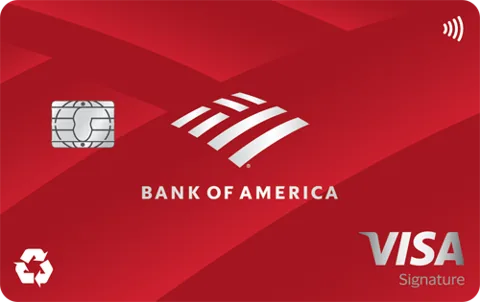
Bank of America Customized Cash Rewards: 3% in a category you choose
A no-fee card paying 3% in a chosen category, 2% on groceries and wholesale clubs, under one $2,500 quarterly cap; it suits a planned category.
The short answer
Bank of America Customized Cash Rewards is a no-annual-fee cash-back card. It pays 3% in a category you choose, 2% on eligible groceries and wholesale clubs, and 1% on everything else. The detail that changes the answer is one allowance: the 3% category and the 2% purchases share a $2,500 cap each quarter.
In Julia's sofa example, a $1,500 online purchase made before the groceries earns $45 at 3%, and the quarter earns $70 on $3,000 of spending. A 2% card such as Active Cash earns $60. The Studio's verdict is "A planned category selected once and used within the shared cap."
The card suits a household with one clear category and a purchase to plan around. For lots of mixed grocery, wholesale and online spending, a flat rate can be easier to predict.
What it costs
There is no annual fee, and the Studio's record shows no membership cost. The comparison throughout is a flat 2% card, such as Active Cash.
The costs to watch sit outside the card. Julia's totals assume you pay purchases without interest, and she points out that borrowing costs can easily outweigh the difference between 3% and 2%. Introductory purchase and balance-transfer rates also come with deadlines and transfer fees. Qualifying for a relationship bonus can cost money too, as the credits section explains.
What it earns
- 3% in the category you choose, the ongoing rate.
- 2% on eligible groceries and wholesale clubs.
- 1% on every other purchase.
- One shared cap: the 3% category and the 2% purchases draw on the same $2,500 each quarter, which the Studio's record counts as $10,000 a year.
The category choices include gas and electric-vehicle charging, online shopping, dining and travel, plus drugstores, and home improvement and furnishings. You can change your selection once each calendar month, and the change is not retroactive. You do not have to change it every month to get value; a useful category can stay selected for a simpler routine.
The card pays cash back. Each $1 in rewards gives you $1 through eligible options such as a statement credit or an account deposit, and there is no airline transfer to work out.
The credits, used honestly
The Studio's record lists no statement credits or other benefits for the card. The nearest thing is the rewards bonus for Bank of America customers, which raises the rewards themselves: a 50% bonus turns a 3% rate into 4.5%, not 53%.
The current program uses qualifying balances, an eligible personal checking account and enrollment. The Member tier offers a 10% bonus. Preferred Plus starts at $30,000 of qualifying balances and offers 25%, Preferred Honors starts at $100,000 with 50%, and Premier starts at $1,000,000 with 75%. If you were enrolled in the earlier Preferred Rewards program before May 26, 2026, your card may have an extended benefit during the transition.
The bonus is worth its face value when your accounts already fit. If moving accounts adds $100 in yearly fees but only $80 of card rewards, you finish $20 worse off, and cash interest, investments and service matter too. For an existing customer those costs might not change at all, which is a stronger reason to count the bonus. Check the rate in your own account. The Studio's score leaves relationship bonuses out.
The catch
The shared cap makes order matter. If $1,500 of groceries comes first, only $1,000 of a later $1,500 sofa earns 3% and the last $500 earns 1%, so the same purchases earn $5 less than in the other order. Julia would consider keeping groceries on another card with a similar rate, which leaves more allowance for the purchases that earn more here.
Choose the category before the purchase. A later change does not apply to an earlier purchase. Online shopping is broad, but not every website payment qualifies: insurance bills, taxes and unrelated services do not become shopping because you paid through a browser.
The first-year offer is a separate promotion. For eligible new cardholders it adds 3 percentage points to the usual 3%, making 6% within the cap, and the usual rate returns after year 1. Do not assume the relationship bonus multiplies that extra amount; check how your offer combines them. The reviewed welcome bonus advertises $200 after $1,000 of purchases in the first 90 days, and your application shows whether you can count it. Julia keeps those years separate, because a planned purchase that works well during an offer does not justify using the card for every later one.
Who it fits
It fits a household with a clear category inside the cap. Julia's example is online shopping for a planned purchase, but the category can follow what the household actually needs, and someone who buys furniture one month and travels the next can change it monthly. It also fits an existing Bank of America customer whose accounts already qualify for a relationship bonus.
It fits less well a household whose grocery, wholesale and online spending is mixed, because those purchases compete for one allowance. Julia would not rearrange food shopping for a difference of $5 to $10.
On the Studio's everyday card test the card scores 60 out of 100. The test compares value after costs across 3 household budgets, then reward flexibility, effort and 2 protection checks. Each budget gets a suitable category, held steady for the year, and temporary first-year rates and banking bonuses that need a separate relationship are left out.
The arithmetic
Julia's sofa quarter has a $1,500 sofa bought online (3%), $1,500 of groceries (2%) and a $2,500 cap shared between them. A flat 2% card earns $60 on the $3,000 in either order.
- Sofa first: the sofa earns $45. The first $1,000 of groceries earns $20 and the remaining $500 earns $5. The quarter totals $70, which is $10 more than the flat card.
- Groceries first: the groceries earn $30. Only $1,000 of the sofa earns 3% and the last $500 earns 1%, so the sofa earns $35. The quarter totals $65, which is $5 more than the flat card and $5 less than the other order.
- A full cap in one category: $2,500 a quarter earns $75 at the ongoing rate against $50 on a 2% card. Over 4 quarters the extra value is $100, not the full $300 of rewards.
- First-year offer, sofa first: the sofa earns $90 instead of $45, and the same grocery rewards bring the quarter to $115. That is $55 more than the flat card and $45 more than the card's ongoing result.
- A 50% relationship bonus, sofa first: $70 becomes $105, which is $45 ahead of the flat card.
Before you apply
Confirm on Bank of America's page which category is selected and what the combined quarterly cap is. Check your application for any first-year offer or welcome bonus, and your own account for your rewards rate, because neither an old chart nor a new-member chart tells the whole story for everyone.
Before a large purchase, look at how much of the allowance your groceries and wholesale shopping have already used. The Studio verified the figures in this article on October 6, 2026.
Rewritten from Julia’s review script (1,223 words); every figure traces to the script or this card’s record. Terms checked Oct 6, 2026.