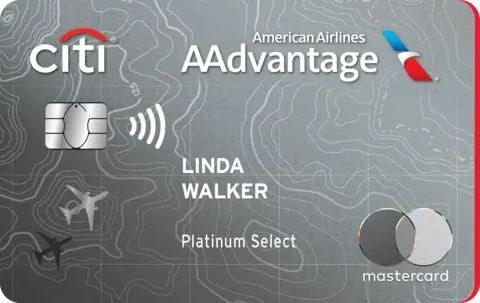
Citi AAdvantage Platinum Select: three suitcases cover the fee, one does not
A $99 card: three checked bags leave Julia $165.60 ahead, but moving $20,000 of spending for its $125 flight discount leaves her $37.50 behind.
The short answer
The Citi AAdvantage Platinum Select World Elite Mastercard is an American Airlines rewards card with miles, preferred boarding and a first checked bag benefit on eligible domestic trips. Its annual fee is $99 after an introductory first year without that fee. The question Julia asks is whether the card can make a trip on American cost less.
For a domestic round trip with three people each checking a bag, the bag benefit saves $264.60 and leaves her $165.60 ahead of the fee. With one shared suitcase it saves $88.20, which does not quite cover the fee. The card's flight discount, $125 after $20,000 of qualifying purchases, costs more than it returns at her net value of 1.2 cents per mile.
The Studio's verdict on fit is "Eligible family checked bags on American and a planned flight originating in the U.S." The card suits less well anyone who would use it for everyday spending. The Wallet Score is 53 out of 100.
What it costs
The annual fee is $99, after an introductory first year without it, and the Studio's rate card lists no membership cost. Julia looks beyond the opening bonus and asks whether she would be happy paying for another year.
The comparison is a no-fee 2% card. Paying bag fees on that card would earn $5.40 on a $270 trip, and ordinary spending on it earns more than this card's miles.
What it earns
- 2 miles per dollar at qualifying restaurants, gas stations and on eligible American Airlines purchases.
- 1 mile per dollar on other eligible purchases.
- 25% back on eligible inflight food and drinks.
- A $125 flight discount after $20,000 of qualifying purchases in a cardmembership year and renewal.
Miles have no fixed cash value. Julia uses a net 1.2 cents, meaning the fare she would actually avoid after award taxes, charges and the rewards she gives up by redeeming, on a flight she could book and would otherwise pay for. At that value a mile per dollar returns 1.2%, and a 2% cash card does better on ordinary spending. The Studio's limitation says the same: "It does not include Admirals Club membership, and 1 mile per dollar on everyday spending is a weak cash-back alternative."
AAdvantage miles can also be useful beyond American-operated flights, subject to the seats partners make available.
The credits, used honestly
- First checked bag: it covers the primary cardholder and up to 4 companions on the same reservation. Every flight must be a domestic American flight or a qualifying American Eagle flight. In Julia's example the Main Cabin tickets would charge $45 per first bag each way when paid online.
- Flight discount: $125 after $20,000 of qualifying purchases. The certificate can take 8 to 12 weeks after qualification to arrive and expires 1 year after issue. Eligible itineraries must originate in the United States, Puerto Rico or the U.S. Virgin Islands, and it cannot pay the taxes on a mileage award ticket.
- Preferred boarding: generally Group 5 on eligible American and American Eagle flights, including qualifying companions on your reservation.
- Turo: up to $30 back per eligible completed trip, up to $180 a calendar year. It requires linking the card through the specified Turo page and paying with it directly, and digital-wallet payments do not qualify. Julia leaves this at $0.
The bag benefit has conditions. An American flight number on a partner-operated plane is not enough, so Julia checks who operates the flight, especially on a connection, and puts her AAdvantage number on the reservation. For a new account the terms require it at least 7 days before travel, and certain phone and paper applications have an additional account-opening timing rule. Normal bag limits apply: there is no second free suitcase and no waiver of overweight charges. If your fare or status already includes the first bag, there is nothing saved.
The catch
The flight discount follows the card's billing-cycle anniversary rules, not December 31, and the account must remain open for a full billing cycle after the anniversary month. Julia reads its change and cancellation terms before using it. She needs a qualifying purchase before the certificate expires, not an intention to fly eventually.
The card does not grant AAdvantage Platinum status despite the name. Qualifying purchases earn Loyalty Points from base miles, but bonus-category miles and the welcome bonus do not convert to the same number. Julia values progress toward status only when she is close to a useful threshold.
An authorized user travelling without the primary cardholder does not independently receive the bag and boarding benefits. On a partner airline, Julia checks that ticket's own baggage allowance, because the American waiver does not follow her there. Preferred boarding is not an Admirals Club membership, and the card gives no lounge access.
Miles are less flexible than cash, and the Studio awards no protection points without current verified coverage. Julia checks the welcome offer's account-history restrictions and pays in full, because interest could quickly use up the savings.
Who it fits
It fits a household that flies American domestically and needs suitcases, as in Julia's trip for three. She would see a practical reason to keep the card, and she would use better-paying cards for other spending rather than force purchases onto it for a discount that might leave her worse off.
It fits less well a household that packs one shared suitcase, flies other airlines, or means to move its whole budget for the discount. The score of 53 reflects value after costs across 3 household budgets, then reward flexibility, effort and 2 specific protection checks; eligible bag savings and the earned flight discount help the value result.
The arithmetic
Bags, 3 suitcases: a round trip has 6 bag charges at $45, or $270. Paying them on a no-fee 2% card would earn $5.40, so avoiding them saves $264.60. After the $99 fee, that is $165.60 ahead from the bags alone.
Bags, 1 shared suitcase: the round-trip charges are $90, and after the same 2% reward the saving is $88.20. That is $10.80 short of the fee, so Julia looks at actual packing and not at the maximum number of companions.
Flight discount: suppose Julia moves $20,000 of ordinary purchases that would earn 2% cash back.
- The card gives 20,000 miles, worth $240 at a net 1.2 cents. The cash card gives $400, so she gives up $160.
- Using all $125 on a ticket she would otherwise buy with the 2% card costs $2.50 of payment rewards, so the discount saves a net $122.50.
- She finishes $37.50 behind on this spending decision.
At a net 1.5 cents per mile, 20,000 miles are worth $300 and the gap shrinks to $100. The same adjusted discount then leaves $22.50 extra, which is much narrower than receiving $125 with no trade-off.
Before you apply
On the issuer's page today, check the $99 fee and the first-year terms, the bag benefit rules, the discount's spending year and routes, and the welcome offer's account-history restrictions. Then open your itinerary, count the bags you would actually pay for, and check the operating airline.
The Studio's rate card carries checked bags at $240, the larger of the $120 and $240 its tests use, and flags it for review. The video's example is $270, so confirm the current fees.
The figures in this article were verified on October 6, 2026.
Rewritten from Julia’s review script (1,268 words); every figure traces to the script or this card’s record. Terms checked Oct 6, 2026.