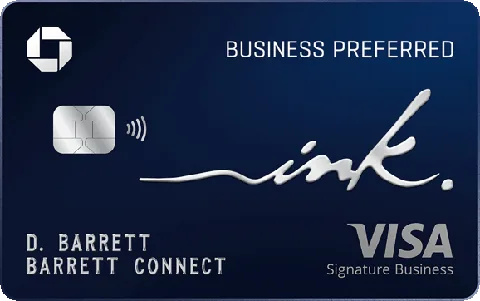
Chase Ink Business Preferred: its $95 fee needs category-heavy spending
3 points per dollar on travel, shipping, internet, phone and advertising for $95. In Julia's category-heavy example it leads Blue Business Cash by $145.
The short answer
Chase Ink Business Preferred has a $95 annual fee and pays 3 Ultimate Rewards points per dollar on eligible travel, shipping, internet, cable, phone and social-media or search-engine advertising. Those categories share a $150,000 cap each account anniversary year, and other purchases earn 1 point per dollar. It also offers travel transfers.
Whether it beats a free card depends on how much of the budget falls in those categories. In Julia's example, an online shop with $36,000 of its $48,000 in qualifying categories keeps $1,105 after the fee, which is $145 more than Amex Blue Business Cash. If only $9,000 qualified, it would keep $565 against $960.
The Studio gives it a Business Wallet Score of 73 out of 100. Its fit note reads, "Shipping, advertising and business travel with useful trip coverage." Its limitation reads, "Category fit matters; cash baseline omits uncertain transfer upside."
It suits a business whose bills are mostly shipping, advertising, internet, phone and travel. It does not suit a business whose spending mostly earns 1 point, where a no-fee card comes out ahead.
What it costs
The annual fee is $95. Julia pays statements in full and assumes no added card-payment fees. She looks at the purchases the business actually makes, because a large budget alone does not justify the card.
The comparison is Amex Blue Business Cash, which has no annual fee and earns 2 percent on the first $50,000 of eligible purchases each calendar year, then 1 percent. At 1 cent per point, Preferred's category advantage over a 2 percent card is 1 extra cent per dollar, and each 1-point purchase on Preferred gives up a penny against that card.
Preferred has no foreign transaction fee, which can help with international spending. Exchange-rate markups and a merchant's currency-conversion offer are separate costs, so compare the full charge.
What it earns
Under the terms Julia reviewed in October 2026, Preferred earns:
- 3 points per dollar on eligible travel, shipping, internet, cable, phone and social-media or search-engine advertising.
- Those categories earn 3 points only up to a shared cap of $150,000 each account anniversary year, then 1 point.
- 1 point per dollar on other ordinary purchases.
The cap resets with your account anniversary, not at the start of the calendar year. The Studio values an Ultimate Rewards point at 1 cent, the cash value.
The credits, used honestly
The Studio's rate card lists no statement credits for Preferred. The extras are transfers and a few smaller benefits, and Julia counts each only where it replaces something the business already pays for.
Preferred has participating airline and hotel transfer programs. From October 1, 2026, it transfers 4 Chase points for 3 Hyatt points, so 8,000 Chase points become 6,000 Hyatt points. Value the Chase points you give up, not a quoted value for each Hyatt point, and compare what an award saves after taxes and fees.
Under Chase's rules you may also combine eligible Ultimate Rewards from other Chase cards into Preferred, which can give a no-fee Ink card's points access to transfers. Compare that redemption with cash and include Preferred's annual fee in the cost.
Benefits such as cell-phone protection might matter, but read the current guide first: the payment requirement, covered losses, deductible, claim limits and exclusions. A large reimbursement headline is not enough reason to cancel existing coverage, because the policies need to cover the same risks.
Preferred currently offers a monthly discount of up to $10 on an eligible DoorDash grocery or retail order after activating the qualifying DashPass benefit. If the same supplies cost $7 more before the discount, the saving is $3, not $10, and extra orders made to chase the discount defeat the purpose. The Studio leaves this time-limited benefit out of its recurring score.
The catch
Advertising does not mean every marketing expense. A print ad or a general agency invoice does not qualify just because it promotes the business. The category follows the merchant and card rules, not the label in your accounts, so check a large advertising bill before moving it.
The $9,500 shortcut has conditions. It says $9,500 of category spending recovers the fee, but only if Preferred handles its 3-point categories and a suitable 2 percent card handles everything else, both cards earn those rates under their caps and no other costs differ. If ordinary 1-point purchases also go on Preferred, the category rewards must cover that lost penny too.
Transfers are an upside, not a baseline. The Studio's score uses the cash value and leaves out an uncertain transfer upside, and Julia would not transfer just because she had a large balance; she would want a booking she could use.
On the application, give accurate personal and business information. A sole proprietor may qualify but still needs accurate revenue information and credit approval. Read the personal-liability agreement, and use the card for business expenses as required. Julia would not buy unnecessary stock to earn an opening bonus.
Who it fits
It fits a business like the online shop in Julia's example, with $36,000 of a $48,000 budget in qualifying categories, where Preferred leaves $1,105 after the fee. It fits more fully where the owner is comfortable splitting purchases, keeping the categories on Preferred and the other $12,000 on a 2 percent card, and where the business has travel it would otherwise pay for and a transfer award it could use.
It fits less well a business where only $9,000 of the same $48,000 qualifies, which keeps $565 against $960 on the no-fee card. It also fits less well an owner who does not want a second account to manage.
The arithmetic
Julia's example is an online shop spending $48,000 a year, with $36,000 in qualifying categories and $12,000 elsewhere. Its merchants qualify, it pays statements in full and there are no added card-payment fees.
- The categories earn 3 points per dollar: 108,000 points. The other $12,000 adds 12,000 points.
- Together that is 120,000 points, or $1,200 at 1 cent per point. After the $95 fee, $1,105.
- Blue Business Cash earns 2 percent on the $48,000, which stays below its $50,000 cap: $960. Preferred leads by $145.
If only $9,000 qualified, those purchases earn 27,000 points and the other $39,000 adds 39,000. That is $660, or $565 after the fee, against $960.
Splitting the first budget keeps the $36,000 on Preferred for $1,080 and puts the other $12,000 on a 2 percent card for $240. After the $95 fee the pair leaves $1,225, which is $120 more than Preferred alone and $265 more than the flat-rate card alone. The shortcut works the same way: 1 extra cent per dollar means $9,500 of category spending recovers the $95 fee.
Before you apply
Check Chase's page for the current categories and the $150,000 cap, the transfer partners and ratios, the foreign transaction fee and the DashPass offer's terms. Read the personal-liability agreement.
Julia reviewed these terms in October 2026, and the Studio's record was checked on October 6, 2026. Terms may have moved since the video, and the $48,000 budget and its split are assumptions to replace with your own.
Rewritten from Julia’s review script (1,245 words); every figure traces to the script or this card’s record. Terms checked Oct 6, 2026.