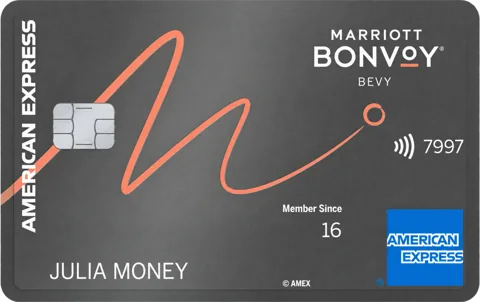
Marriott Bevy: the $250 fee needs $15,000 of spending and a usable night
In Julia's example, rewards leave Bevy $142.60 behind the $250 fee until the certificate adds $176.20, a $33.60 lead that a 3% card erases.
The short answer
The Marriott Bonvoy Bevy American Express Card is a personal hotel rewards card for someone who wants everyday purchases to support regular Marriott travel. The annual fee is $250, and paying it does not deliver the annual night. The certificate needs $15,000 of eligible purchases in the calendar year, with a limit of 1 certificate per year.
In Julia's example, a family spending $15,000 earns 58,200 points, worth $407.40. That is $107.40 more than a 2% card and still $142.60 behind after the fee. A certificate used for a 45,000-point night that would cost $190 in cash saves $176.20 and puts Bevy $33.60 ahead for the year. That is a small margin, and it disappears against a 3% card on the same groceries and meals.
So the card suits a household that would spend about $15,000 on the card anyway, across food and Marriott stays, and has a night it needs. It suits less well one that would divert purchases from better rewards or invent another trip. The Studio's verdict on fit is "Qualifying food spending, paid Marriott stays and enough existing spending to earn a useful certificate." Its Wallet Score is 48 out of 100.
What it costs
The annual fee is $250, and the Studio's rate card lists no membership cost. The fee alone does not deliver the annual night. Julia is choosing both a card and where to put a substantial part of the family budget, so she compares Bevy with the cards she would otherwise use.
The comparisons are a no-fee 2% card on the same $15,000 and a no-fee 3% card on the same groceries and meals. She also puts Marriott Bonvoy Boundless beside it. Boundless costs $95 a year and supplies an anniversary night without Bevy's $15,000 spending requirement, although its certificate has a lower points limit. That is a $155 difference in annual fees.
What it earns
- 6 Marriott points per dollar on eligible Marriott hotel purchases, plus 1,000 bonus points for each eligible paid stay booked directly with Marriott.
- 4 points per dollar at restaurants worldwide and U.S. supermarkets, on the first $15,000 of combined purchases in those categories each calendar year, then 2 points.
- 2 points per dollar on other eligible purchases.
The stay bonus is per stay, not per night, so a longer visit does not earn more of it. Julia values points at a net 0.7 cents each, meaning the travel spending she would actually avoid after extra costs and the rewards she gives up by redeeming. The Studio's rate card uses 0.6 cents.
The credits, used honestly
- Annual night. The earned certificate covers an available standard-room award night priced at up to 50,000 points. If the night you want costs more, you can add up to 25,000 Marriott points, but the value of those points comes off the saving.
- Stay bonus. 1,000 points per eligible paid stay is worth $7 at Julia's value.
- Status. Gold status and 15 elite night credits each calendar year, subject to account limits. The credits help toward status; they are not 15 nights to book. The Studio's limitation says: "Gold benefits already available elsewhere add no value."
The catch
The certificate is earned, not automatic. Marriott allows 8 to 12 weeks after you meet the spending requirement for it to arrive, and it expires 1 year after issuance. Your account needs to remain open and not in default when it is issued. You also need eligible award availability and a stay before the expiry, and resort fees and incidentals can still apply.
Two thresholds share one number but measure different things. The category cap limits the higher earning rate, while the certificate threshold counts eligible purchases across the card. Julia leaves out fees, interest, gift cards and cash-like transactions when checking whether she has earned the certificate. Superstores and warehouse clubs do not count as U.S. supermarkets, so a grocery budget only helps if the stores qualify.
Interest would quickly change the result, so Julia's sums assume the balance is paid in full and no extra purchase fees apply. She also keeps any welcome offer separate, after checking the current spending requirement and whether her card history makes her eligible.
Who it fits
Bevy fits a household with spending that already clears $15,000 on a mix of food and Marriott stays, a night it needs within the certificate's 50,000-point limit and time to use it before expiry. Julia would consider it if those pieces lined up.
It fits less well a household that already earns 3% on groceries and meals, since Bevy then finishes behind. It also fits less well one that would have to invent another trip or move spending away from better rewards, where Julia would keep the simpler option. Gold status the household already has elsewhere adds nothing.
The Wallet Score of 48 compares value after costs across the same 3 household budgets, then reward flexibility, the work involved and 2 specific protection checks. The Studio's budgets clear the threshold, but the higher fee and hotel-specific rewards still limit the result. It uses 0.6 cents per Marriott point and tests the loss of the biggest benefit.
The arithmetic
Julia's year: 3 eligible paid Marriott stays booked directly, with $1,800 of hotel charges on the card, plus $9,000 in the qualifying food categories and $4,200 of ordinary eligible purchases. That reaches $15,000.
- Points: purchases plus 3 stay bonuses of 1,000 total 58,200 points, worth $407.40 at 0.7 cents.
- Against a 2% card: $15,000 earns $300 in cash, so Bevy's extra rewards are $107.40. After the $250 fee, Bevy is $142.60 behind.
- The certificate: an eligible room costs 45,000 points, and the cash alternative costs $190 with taxes and no resort fee. A 2% card would earn $3.80 on it, and hotel rewards she would value at $10 are given up too, so the certificate saves $176.20.
- The year: $176.20 covers the earlier shortfall and leaves Bevy $33.60 ahead.
- Against a 3% card: a no-fee card earning 3% on the same groceries and meals improves her alternative by $90, so Bevy finishes $56.40 behind.
- Against Boundless: the stay bonus is worth $7 a stay, so on that benefit alone Bevy would need 23 eligible stays to exceed the $155 fee difference. That is not a complete comparison, but it shows why 3 stays are not enough reason.
Julia assumes she already has Marriott Gold through another route, and keeps the hotel-program rewards she would earn either way out of the card comparison.
Before you apply
On the issuer's page today, check the $250 fee, the $15,000 requirement and what counts toward it, the 50,000-point limit, the 25,000-point top-up allowance and the delivery time. Then look at your own spending, because the certificate only helps if the purchases would be made anyway.
Julia values points at 0.7 cents, while the Studio's record uses 0.6 cents, so the point-based totals are a little lower at the Studio's value. The rate card counts the certificate at $200, where her example saves $176.20. The terms may have moved since the video, so confirm current amounts.
The figures in this article were checked on October 6, 2026.
Rewritten from Julia’s review script (1,253 words); every figure traces to the script or this card’s record. Terms checked Oct 6, 2026.