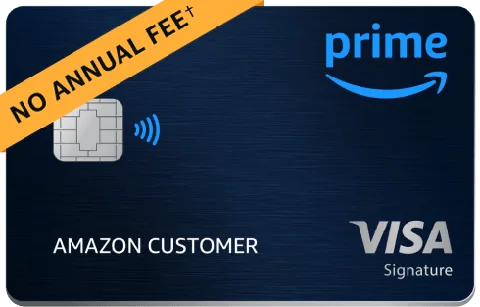
Prime Visa: 5% on Amazon and Whole Foods, but only with a Prime membership
A no-fee cash-back card paying 5% at Amazon and Whole Foods with Prime; the gain depends on whether you would keep Prime anyway.
The short answer
Prime Visa is a cash-back credit card with no annual fee. With an eligible Prime membership it pays 5% at Amazon.com, Audible.com, Whole Foods Market and through Chase Travel, 2% at restaurants, gas stations and local transit, and 1% on other purchases. The decision is really two: whether you want Prime, and whether you want the card.
If you would keep Prime anyway, Julia's example is $450 a month on eligible Amazon and Whole Foods purchases. That is $5,400 a year and $270 back, against $108 from a no-annual-fee 2% card, a gain of $162 without changing what you buy. If you would join Prime only for the card, the membership adds $108 in rewards over an eligible non-Prime Amazon Visa, not the full $270, and that $108 has to cover the membership price.
The Studio's one-line fit is "Existing Prime households with Amazon/Whole Foods spending."
What it costs
The card has no annual fee. The cost is the Prime membership that unlocks 5%. The Studio's score charges the full ordinary annual Prime cost, which its record puts at $139, and notes that an existing member faces a different, incremental decision. A higher membership price than the extra $108 would not be covered by rewards alone on this budget.
For a different membership price, divide the annual cost you need the rewards to cover by 2%. If that cost were $100, you would need $5,000 of eligible spending to recover it through the extra reward. Other Prime services count only at what they are independently worth to your household; an advertised service price is not money saved if you would not otherwise pay for the service.
The comparisons are an eligible non-Prime Amazon Visa, which earns 3% on qualifying purchases, and a no-annual-fee 2% card.
What it earns
- 5% at Amazon.com, Audible.com, Whole Foods Market and through Chase Travel, with an eligible Prime membership. Other eligible program purchases qualify too.
- 2% at restaurants, gas stations and local transit.
- 1% on other purchases.
The Studio's test assumes 40% of online shopping is on Amazon, which makes a blended 2.6% online. The rewards are tracked as points, but they are Amazon card rewards. Chase issuing the card does not turn them into transferable Ultimate Rewards, so use the value shown for your chosen redemption, not a travel-point value from another Chase card. Cash can go toward the airline, hotel or travel expense you actually choose. There is no transfer opportunity, but no award seat to find either.
The credits, used honestly
The Studio's record lists no statement credits for the card. Two related details can look like credits.
An opening Amazon gift-card offer, if you qualify, belongs in the first-year column. It could help with planned Amazon spending, but it is not cash in your bank account and does not repeat every year. Check the current offer and eligibility.
Rewards used at Amazon checkout are not a new card charge, so that portion earns no further purchase reward. If cash redemption gives equivalent value and you will pay in full, you can pay normally and redeem cash separately, which preserves rewards on the charged purchase. If checkout offers special financing, check whether choosing it replaces the normal rewards, and do not count 5% on an option that excludes it.
On protection, the Studio's checks find an eligible damaged item covered but no trip cancellation cover in the card's benefits guide.
The catch
Prime membership is required for the 5% rate, and not every purchase earns it. Checkout eligibility matters too. Amazon Pay at an unrelated merchant is not the same as buying on Amazon.com, international Amazon sites do not automatically get the elevated rate, and Whole Foods purchases through an excluded third-party service may earn differently.
Chase Travel needs the qualifying booking route. Compare the full fare or room price, cancellation terms, baggage and any benefits you would give up, because 5% is not enough information by itself.
Using the card on weaker purchases erodes the advantage, as the arithmetic below shows. And the rewards assume you pay the statement balance in full: earning $50 on a $1,000 purchase can still be outweighed by expensive revolving interest.
Who it fits
It fits a household that already wants Prime and spends on Amazon and Whole Foods, with a second card for spending that earns less. Julia would be comfortable with two statements if they were easy to manage, and would weigh a harder setup against the extra reward. It fits less well someone joining Prime only for the card, where the membership has to make sense within the extra $108 or provide other services the household values.
On the Studio's everyday card test, Prime Visa scores 55 out of 100. The test compares value after costs across 3 household budgets, then reward freedom, effort and 2 protections. It charges the full annual Prime membership and includes plenty of shopping away from Amazon, which holds down the grade even though eligible Amazon spending earns well. The score tests the whole arrangement from scratch; Julia's own decision would depend on whether the household would keep Prime anyway.
The arithmetic
- Without Prime, $5,400 of eligible purchases earns $162 at 3%. With Prime it earns $270 at 5%. The membership adds $108.
- For an existing member, $450 a month is $5,400 a year: $270 on Prime Visa against $108 on a 2% card, a gain of $162.
- Adding $12,000 of ordinary 1% spending earns $120, for $390 in all. A 2% card earns $348 on the whole $17,400, so Prime Visa leads by only $42.
- Keeping the roles apart, $5,400 on Prime Visa and $12,000 on a 2% card earn $510, which is $120 more than using Prime Visa for everything.
- Price first: an appliance costs $180 on Amazon and $170 at another reliable retailer. After 5% back Amazon costs $171; after 2% back elsewhere it costs $166.60, so the smaller reward saves another $4.40.
Before you apply
Settle the Prime decision first, then the card. Check the qualifying merchants and checkout routes on Chase's page, since the 5% terms the Studio reviewed were from October 2026, and check the current opening Amazon gift-card offer and your eligibility. The Studio checked these terms on October 6, 2026.
Rewritten from Julia’s review script (1,074 words); every figure traces to the script or this card’s record. Terms checked Oct 6, 2026.