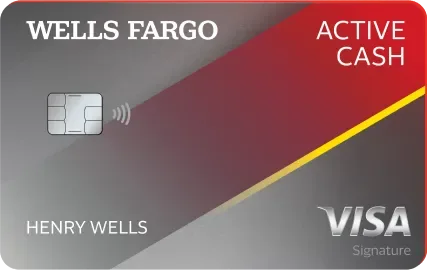
Wells Fargo Active Cash: a steady 2% card that adds $108 over a 1.5% card
Active Cash earns a flat 2%: $108 more than a 1.5% card on $21,600 of spending, nothing more than another 2% card, and costly abroad with its 3% fee.
The short answer
Wells Fargo Active Cash is a no-annual-fee cash-back card with a steady 2% rate on eligible purchases and no bonus categories to follow. It suits a household that wants one everyday card for ordinary spending at home.
In Julia's example, a family spending $1,800 a month earns $432 a year, which is $108 more than a 1.5% card would earn on the same purchases. If you already hold a 2% card, moving those purchases adds $0, so a benefit or an eligible introductory offer has to make the change worthwhile.
The card is a weaker fit abroad, where its 3% foreign transaction fee outweighs the reward, and for payments that add a surcharge. The Studio's Wallet Score is 70 out of 100. Its verdict on fit is "Simple unrestricted cash back across accepted purchases." Its limitation: "No accidental-purchase or cancellation cover in these two specific tests; phone protection is outside them."
What it costs
There is no annual fee, and the Studio's rate card lists no membership cost. The costs sit elsewhere: a 3% foreign transaction fee, any payment surcharge on rent, tuition or other services, and a fee on balance transfers.
Julia compares the card with a 1.5% card and with a 2% card you may already hold. A welcome offer is a first-year extra and stays separate from the ordinary years.
What it earns
- 2% on eligible purchases, with no categories to track or activate.
The rate does not depend on where spending goes. If grocery spending falls and home repairs rise, Active Cash does not need a new plan.
These are cash rewards, so there are no airline-point values to work out. $1 of rewards can give $1 through an eligible account-credit redemption. Wells Fargo offers options including credits to eligible accounts and redemptions against qualifying past purchases, so the cash route can fit your routine.
The credits, used honestly
Active Cash has no recurring credits. Its one extra benefit is cell phone protection, and it comes with conditions.
- Cover: paying the full eligible monthly wireless bill can cover qualifying damage, theft, or involuntary and accidental parting.
- Limits: a $25 deductible, up to $600 per approved claim, and at most 2 paid claims in 12 months. A mysteriously missing phone and certain electronic or software failures are not covered.
- Start date: coverage begins on the first day of the month after the first qualifying bill payment. Buying the phone with the card is not enough, and the full monthly bill has to keep being paid with an eligible card.
- Supplemental: the benefit guide controls eligibility and explains how the cover works alongside other insurance.
Julia keeps the rewards and the phone protection separate. The steady cash is part of the budget, while a possible insurance claim is not, so she does not add the $600 limit to the annual reward total.
The catch
Paying the phone bill by card can remove a discount from the carrier. Julia checks that before moving the bill, because the protection has to be worth what the discount costs.
Abroad, the 3% foreign transaction fee takes more than the 2% reward earns. Active Cash can stay in use at home while a card without a foreign transaction fee handles the trip. At home, a 2% reward does not cover a 3% processing charge on rent, tuition or another service.
A statement credit is not a required payment. It reduces the balance; it does not replace the payment due. In the Studio's damaged-purchase and illness-cancellation tests, the benefits guide contains no payable benefit, so the card earns no protection points there.
If a balance needs much longer to repay than an introductory period allows, another card may fit better, even one with no ordinary rewards. Finishing the balance matters more than a small reward.
Who it fits
Active Cash fits a household whose spending moves around, across groceries, clothing, dining and repairs, and that does not want to follow bonus categories. In Julia's example that is $1,800 a month on a card paid in full.
It fits less well when a 2% card is already in the wallet, when a lot of spending is abroad, or when moving the phone bill would cost a carrier discount. A household happy to manage two cards can add a 3% category card for part of its spending, as the example below shows.
Julia would consider Active Cash for everyday purchases at home, without asking it to handle overseas spending or a long repayment plan. Her current card and her actual phone bill would tell her whether switching was worthwhile.
The arithmetic
Everyday spending: $1,800 a month is $21,600 a year. At 2%, Active Cash earns $432. A 1.5% card would earn $324, so Active Cash adds $108. Against a card that already earns 2%, it adds $0.
Paired with a category card: if $6,000 of the budget qualifies for 3% on another no-fee card, that card earns $180 and the rest of the spending earns $312 on Active Cash. Together they return $492, which is $60 more than Active Cash alone. The first card already earns most of that $492, so it is not all new value.
Phone bill: $100 by card, or $90 with another eligible payment method, earns $2 on Active Cash. The card-paid cost is still $98, which is $8 more a month, or $96 a year. A fully eligible $300 repair, less the $25 deductible, could reimburse $275 if no other insurance reduces it. That exceeds the extra $96 over the year, but approval is not automatic and a claim may never be needed.
Abroad: $1,000 earns $20 at 2% and incurs $30 in fees, a $10 loss. A 1.5% card without a foreign fee earns $15 on the same purchase, which is $25 better.
Welcome offer: the current public offer is $100 after $500 of purchases in the first 3 months, and offers can vary by channel and eligibility. With it, first-year rewards would reach $532. In later years the ordinary $432 returns.
Introductory financing: the current offer provides 12 months at 0% from account opening for purchases and qualifying balance transfers, and transfers within 120 days can qualify for the introductory rate and fee. A $1,200 purchase at the start of the purchase promotion could be cleared early with 10 payments of $120. Transferring $5,000 at the introductory 3% fee adds $150 to the balance, and the transfer does not earn 2% back, so rewards will not cancel the fee.
Before you apply
On the issuer's page today, check the welcome offer on your own application, the 12-month introductory period and the transfer fee, the 3% foreign transaction fee, and the phone-protection terms. Look at your phone bill, your current card and whether a carrier discount would be lost before deciding.
The figures in this article were verified on October 6, 2026.
Rewritten from Julia’s review script (1,171 words); every figure traces to the script or this card’s record. Terms checked Oct 6, 2026.