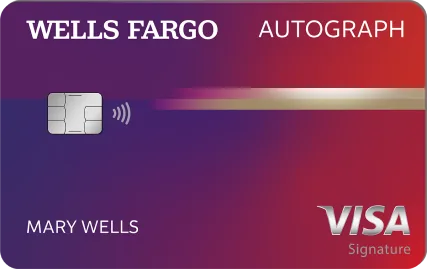
Wells Fargo Autograph: 3 points on six everyday categories, no annual fee
A no-fee card paying 3 points per dollar on dining, travel, gas, transit, streaming and phone plans; it pairs with a 2% card for everything else.
The short answer
Wells Fargo Autograph is a no-annual-fee rewards card, separate from Autograph Journey. It earns 3 points per dollar on restaurants, travel, gas, transit, popular streaming and phone plans, and 1 point on other purchases. Eligible cash redemptions are worth 1 cent per point, and there is no foreign transaction fee.
In Julia's example, a household that spends $14,800 in those categories and $10,000 on everything else earns $544 from Autograph. No-fee Citi Double Cash earns $496 on the same $24,800, so Autograph leads by $48. The lead depends on the mix: move $4,000 from the bonus categories to ordinary purchases and Autograph earns $464, which is $32 behind the flat card.
The Studio's one-line fit is "Broad dining, travel, gas, transit, streaming and phone earning without annual fee." A household that wants exactly one card, and whose purchases mostly miss the six categories, may find a flat 2% card stronger.
What it costs
There is no annual fee, and the Studio's record shows no membership cost. There is no foreign transaction fee either, while Double Cash charges 3% on foreign purchases.
The comparison throughout is no-fee Citi Double Cash, whose 2% comes from 1% when you buy and another 1% through eligible payments. The card also offers a 0% introductory purchase APR for the first 12 months, followed by a variable rate. That may help with a planned purchase if you can repay it before the introductory period ends.
What it earns
- 3 points per dollar on restaurants, travel, gas, transit, popular streaming and phone plans.
- 1 point per dollar on other purchases.
- Eligible cash redemptions at 1 cent per point, so 3 points are worth 3 cents.
The travel category includes travel agencies and discount travel sites alongside airlines, hotels, vehicle rentals and certain other merchants, so you do not always have to book directly. Check the merchant classification, and check Wells Fargo's eligible popular-services list for streaming. Qualifying restaurants and transit abroad can still earn 3 points.
To transfer points to a select travel loyalty program, Julia would find a suitable booking first. She compares the partner points received, the points required, taxes and a suitable cash fare. Transfer ratios differ by program, and transfers are final. A value quoted for a partner mile is not automatically the value of a Wells Fargo point, and cash at 1 cent each remains the fallback.
The credits, used honestly
The Studio's record lists no statement credits for the card. The nearest thing is a separate benefit tied to the phone bill. Paying the total eligible monthly wireless bill with the card can earn 3 points and activate supplemental protection for qualifying damage or theft.
The limit is up to $600, with a $25 deductible and at most 2 paid claims per 12 months. Mysterious loss and electronic or software failure are excluded. Coverage starts on the first day of the following calendar month, and you need to keep making qualifying bill payments and retain the bill, proof of payment and claim documents.
Julia would not call that protection free before checking the carrier discount: losing a bank-payment discount could cost more than the rewards. The Studio's score leaves the phone coverage out ("cell protection outside scope"), and it credits no payment for its 2 fixed insured-loss tests, purchase damage and trip cancellation.
The catch
Ordinary purchases give the advantage back. A $100 meal at a qualifying restaurant earns $3 in cash on Autograph against $2 on the flat card, but $100 of ordinary supermarket groceries earns $1 against $2. As the only card at these cash values, more than 50% of your spending would need to qualify for the 3-point rate to beat a 2% card.
If another card you own already rewards the same categories, the extra value could be smaller. Julia weighs the gain against the cards she holds and the effort of another account.
The public welcome offer Julia reviewed is 20,000 points after $1,000 of purchases in 3 months. It is a separate introductory benefit, and it counts only if your eligibility and planned spending meet the actual offer.
Who it fits
It fits a household with a large share of its spending in dining, travel, gas, transit, streaming and phone plans, using a 2% card for groceries and other ordinary purchases. It fits less well a household that wants one card and spends mostly outside those categories, or one whose other cards already reward the same categories.
On the Studio's everyday card test, Autograph scores 67 out of 100. The test compares value after costs across 3 household budgets, then reward flexibility, effort and 2 protections. Broad bonus categories, usable cash rewards and no annual fee give it a useful foundation; groceries and other ordinary purchases hold the earning result back.
The arithmetic
Julia's budget has $6,000 a year at restaurants, $4,000 on travel, $3,000 on gas and transit, $360 on streaming and $1,440 on a phone plan, $14,800 in all, plus $10,000 of other purchases.
- Autograph alone: the bonus categories earn $444 and other purchases $100, for $544.
- Double Cash earns $496 on the same $24,800, so Autograph leads by $48.
- After moving $4,000 to ordinary purchases, $10,800 earns 3 points and $14,000 earns 1. Autograph returns $464 against the flat card's $496, which is $32 behind.
- As a pair on the original mix, Autograph earns $444 and Double Cash $200 on the other $10,000, for $644, or $148 more than Double Cash alone.
- As a pair on the second mix, Autograph earns $324 and the fallback $280, for $604, or $108 more than the flat card alone.
Before you apply
Check a recent statement for the purchases Autograph would actually improve, then decide whether that is an easy routine to keep. On Wells Fargo's page, confirm the category list, the streaming list, the current welcome offer and introductory APR, and the phone protection terms. The Studio checked these terms on October 6, 2026.
Rewritten from Julia’s review script (1,019 words); every figure traces to the script or this card’s record. Terms checked Oct 6, 2026.