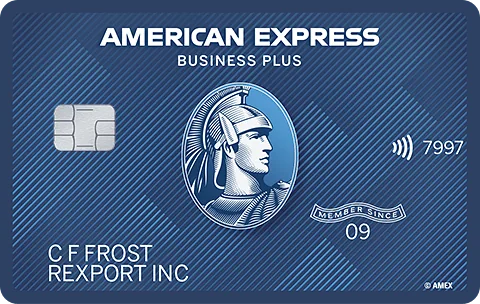
Amex Blue Business Plus: it beats 2% cash back only above 1 cent per point
No annual fee and 2 points per dollar on the first $50,000 a year. In Julia's example the points tie 2% cash at 1 cent and trail it at 0.6 cents.
The short answer
American Express Blue Business Plus has no annual fee and earns 2 Membership Rewards points per dollar on the first $50,000 of eligible purchases each calendar year, then 1 point. Whether that beats 2 percent cash back depends on what you can get for the points. They tie the cash card at a net 1 cent each and fall behind below that.
In Julia's example, a business spending $36,000 earns 72,000 points on Plus or $720 on Blue Business Cash. Used only for statement credits at 0.6 cents per point, the points are worth $432, which is $288 less than the cash. At a net 1.5 cents they are worth $1,080, or $360 more.
The Studio gives it a Business Wallet Score of 63 out of 100. Its fit note reads, "Businesses wanting points without a recurring annual fee." Its limitation notes that "Fixed flight redemption is less flexible than cash" and that the upside from transfers is not certain.
It suits a business with a practical travel use for transferable points. It does not suit a business that expects to redeem mainly for standard statement credits.
What it costs
There is no annual fee. Julia pays in full and avoids card surcharges, so the comparison is about rewards alone.
The alternative is Amex Blue Business Cash, which also has no annual fee and earns 2 percent on the first $50,000 of eligible purchases each calendar year, then 1 percent. The names are similar, but one pays points and the other pays cash.
Two costs sit around the card. Blue Business Plus charges a foreign transaction fee, which is a real cost even when you earn rewards, and a suitable card without that fee is often a simpler comparison for international purchases. A vendor surcharge can also erase the reward: paying a 3 percent fee to earn points worth 2 percent loses money.
What it earns
Under the terms Julia reviewed in October 2026, Plus earns 2 points per dollar on the first $50,000 of eligible purchases each calendar year, then 1 point. Eligible AmexTravel.com purchases earn 2 points under a separate rule and do not count toward the $50,000 allowance. Check the booking requirements before relying on that exception.
The Studio values a point at 1 cent, the fixed flight-booking option through Amex Travel that it uses for the score. Julia's examples run from 0.6 cents for statement credits to a net 1.5 cents on a flight she would otherwise buy, so the redemption decides the result.
The credits, used honestly
Blue Business Plus has no statement credits, and the Studio's rate card lists no benefits beyond its earning rates. What needs honest valuation is how the points are redeemed.
Statement credits are the low end. Amex's standard Cover Your Card Charges option generally gives 0.6 cents per point, so check the redemption screen rather than assume every use of points has the same value.
Flights can be worth more, but only against a ticket you would actually buy. Julia does not price an expensive cabin she would never choose, and she includes any transfer cost.
Transfers carry their own costs. Amex currently charges an excise-tax-offset fee of $0.0006 per point, capped at $99, for transfers to U.S. airline frequent-flyer programs, so transferring 72,000 points costs $43.20. Non-U.S. programs do not have that particular fee, but they can have award taxes, surcharges and different availability. Plus itself offers eligible partner transfers, so you do not need a premium annual-fee card just to transfer its points.
Points are not a savings account. An airline can change what an award costs before you book, and if a work trip moves from this spring to 2 years from now, the cash option deserves another look.
The catch
The cap is the first catch. Beyond $50,000 of eligible purchases in a calendar year, Plus earns 1 point per dollar, and choosing points does not remove that limit. A business that outgrows it may want another card for the later purchases.
The second is flexibility. The Studio's score uses a fixed 1 cent flight booking through Amex Travel, and the booking requirement and redemption minimum cost flexibility compared with cash. A strong transfer could improve one business's result, but Julia would not assume it for everyone.
The third is Expanded Buying Power. Depending on the account and Amex's assessment, it might let a business spend above its credit limit. That is not unlimited spending, a promise of financing or extra income, and amounts above the limit have their own payment requirements to check before the purchase.
Keep household purchases separate from business expenses. A rewards plan does not override business-card terms, and appearing on a business statement does not automatically make a purchase deductible.
Who it fits
It fits a business with a practical travel use, like the translation business in Julia's example that pays for occasional trips and has $36,000 a year of eligible domestic expenses. Its points matter when a trip the business actually needs can be booked for points at a net value above 1 cent each. Plus also fits a quieter year, because there is no annual fee to recover just to keep earning transferable points.
It fits less well a business that would redeem mainly for statement credits, where the predictable $720 from Blue Business Cash beats 72,000 points worth $432, or one whose spending runs past $50,000 a year and would need another card for the rest.
The arithmetic
Julia's example is a translation business with $36,000 of eligible domestic expenses, paid in full, with no surcharges.
- Plus: $36,000 at 2 points per dollar is 72,000 points.
- Blue Business Cash: $36,000 at 2 percent is $720.
- Statement credits at 0.6 cents: 72,000 points are worth $432, or $288 less than the cash.
- A net 1 cent per point: $720, a tie. A net 1.5 cents: $1,080, or $360 more.
A flight test shows how the net value moves. If a flight costs $600, or can be booked with 36,000 points plus $60 in unavoidable charges, the points replace $540, which is 1.5 cents each. If a comparable flight costs $420, the same award saves only $360 after its $60 charge, which is 1 cent per point.
At $60,000 of ordinary purchases, the first $50,000 earns 100,000 points and the remaining $10,000 adds 10,000, for 110,000 points rather than 120,000. Blue Business Cash earns $1,000 below its cap and $100 above it, for $1,100, so at 1 cent per point the cards still tie.
Before you apply
Check Amex's page for the current earning terms and the $50,000 cap, the fee for transfers to U.S. airline programs and the transfer partners, the statement-credit rate, the Amex Travel booking requirements, Expanded Buying Power and the foreign transaction fee.
Julia reviewed these terms in October 2026, and the Studio's record was checked on October 6, 2026. Terms may have moved since the video, and her trip prices, point values and budgets are assumptions to replace with your own.
Rewritten from Julia’s review script (1,221 words); every figure traces to the script or this card’s record. Terms checked Oct 6, 2026.