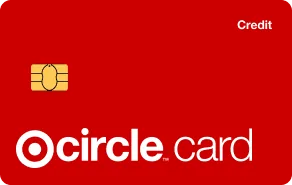
Target Circle Credit Card: 5% off at Target only, and debit gives it too
A no-annual-fee store card taking 5% off eligible Target purchases; a debit version gives the same core discount without a borrowing account.
The short answer
The Target Circle Credit Card is a no-annual-fee store card that discounts eligible purchases when you pay with it. It takes 5% off at Target and Target.com, with no points to redeem afterward. It works only at Target, so the question is how much of your spending lands there.
In Julia's example, $2,250 of eligible Target merchandise saves $112.50, against $45 on a 2% card, a gain of $67.50 a year. That is the amount to weigh against managing a new payment product. The debit version gives the same core discount, so you do not have to open a borrowing account to get the saving.
The Studio's one-line fit is "Eligible purchases already planned at this merchant." Its Wallet Score is 41 out of 100: the discount is easy to use, but Target is only part of the spending and the card cannot handle the rest. It suits a family that regularly buys at Target. It fits less well as a card for everyday spending, or if you would carry a balance.
What it costs
There is no annual fee. The costs sit around the card. Interest comes first: an eligible $800 purchase saves $40 at 5%, but if carrying the balance cost $60 in interest, you would end up $20 worse off than paying full price without that borrowing cost. Julia would set aside money for the bill so she could pay it in full.
Membership is the second cost to watch. Circle 360 is a paid membership with its own benefits and rules, and opening the card does not make every subscription benefit free. If a cardholder offer gets you to buy a membership you did not otherwise want, include that new expense. If you would buy it anyway, count only the actual reduction in its price.
The comparison is a 2% card, the debit version of the same discount, and a competitive price elsewhere. The Studio's limitation line calls this a companion store card that counts nothing on other merchants, and notes that a debit alternative may give Target's same discount.
What it earns
- 5% off eligible purchases paid with the card at Target and Target.com, taken as a discount, not points.
- Nothing on spending elsewhere: the Studio's rate card describes 5% off at Target only, with no earning on everyday spending.
Not everything at Target counts. Exclusions can include Target GiftCards, certain prepaid cards, pharmacy purchases and fees, so Julia compares the current list with what the family actually bought. Other discounts and promotional gift cards can change the eligible amount too. You cannot add every percentage shown beside an item; use the final amount that qualifies under the rules.
Splitting the payment changes the amount. On $100 of eligible merchandise paid partly with a $40 gift card you already have, only the remaining $60 goes on the Circle Card, and the 5% discount on that portion is $3. Julia would avoid counting a $5 discount on money the card never pays.
The credits, used honestly
The card has no statement credits. Its extras are conditional, and Julia counts one only when she would actually use it.
- Returns: 30 extra days for eligible returns beyond an item's standard policy. Exceptions apply; an excluded or nonreturnable item does not become returnable because you used the card. Check the product's policy if extra time matters.
- Shipping: free standard shipping, plus free 2-day shipping for eligible items and locations. Special delivery, item restrictions and minimum thresholds can still matter, and a saved shipping charge counts only if you would have paid it.
- Names: Target Circle is the loyalty program, Circle Card is the payment product and Circle 360 is the paid membership. Some people hold a Target Mastercard with outside-Target features, which does not automatically come with every store-only Circle Credit Card. Read the version you are offered and where it can be used.
The catch
The eligible amount is smaller than the receipt. Using the whole $2,680 in Julia's example would overstate the saving, because $430 of it was excluded items or charges.
The price of the item still comes first. A $180 item falls to $171 with the 5% discount. The same item at $170 elsewhere, with equivalent delivery and returns, costs $166.60 after a 2% reward, which saves another $4.40. If Target started at the same or a lower price, it could win, so compare the total.
Debit and credit are different products even though they share a discount. Debit draws from linked checking, so you need enough money there. Credit creates a bill under its own terms, so you need a reliable payment routine. Their dispute rules, account access and timing differ. The checkout line is not where Julia would want to read a new account's terms for the first time, so she gives herself time for that choice.
On protection, the Studio's two checks found no payable coverage. The published benefit schedule has no accidental-damage insurance, and a closed-loop store card cannot buy a common-carrier fare.
Who it fits
It fits a household that regularly buys eligible merchandise at Target, checks its receipts and compares prices. For that household, Julia would value the immediate discount while choosing the payment arrangement that suits the family. If she wanted to avoid another borrowing account, she would read the debit terms first. If she preferred the credit arrangement, she would decide whether the additional statement was worth managing.
It fits less well if most of your spending is elsewhere, since the card cannot handle the rest and that holds the score down. It also fits less well if you would borrow for purchases or buy a membership only because of an offer. Julia reads the card as a narrow role, not a reason to dismiss the savings on an eligible Target order.
The arithmetic
Julia's year is $2,250 of eligible Target merchandise and $430 of excluded items or charges.
- Eligible purchases: 5% off saves $112.50 before sales-tax effects. A 2% card would earn $45 on the same merchandise, so the Target discount gains $67.50.
- The whole receipt: $2,250 plus $430 is $2,680. Treating all of it as eligible would overstate the saving.
- A split payment: on $100 of eligible merchandise with a $40 gift card, only $60 goes on the card, and the discount is $3 rather than $5.
- Price check: $180 at Target is $171 after the discount. $170 elsewhere with a 2% reward is $166.60, a further $4.40 saved.
- Borrowing: an $800 purchase saves $40, but $60 of interest leaves you $20 behind.
Before you apply
Use 3 recent Target receipts to check which purchases were eligible, and compare the prices with realistic alternatives. On Target's page, read the program rules for the current exclusion list, the 30-day return extension and the shipping conditions, and read the debit and credit terms side by side. For Julia's budget the extra saving is $67.50, available through either the core credit or debit discount. The Studio checked these terms on October 6, 2026.
Rewritten from Julia’s review script (1,195 words); every figure traces to the script or this card’s record. Terms checked Oct 6, 2026.